Whales and the gulf
The right whale's new summer range
Fewer than four hundred North Atlantic right whales remain. In the last decade many have shifted their summer feeding into the Gulf of St. Lawrence, and that move has changed how the gulf is managed.
- Getting there
- Mostly the southern gulf, far offshore
- Bring
- Binoculars and a way to report sightings
- At sea
- Right whales feed slowly near the surface and are hard to see in any chop; most sightings are well offshore in the southern gulf.
- From Chéticamp
- Mostly far offshore; rarely seen from here
The North Atlantic right whale is one of the most endangered large whales in the world. Its population is now estimated at fewer than four hundred animals, and for several years more of them have died than have been born. Most visitors to Cape Breton will never see one. But this whale has reshaped how the Gulf of St. Lawrence is fished and travelled, and it is worth knowing why.
A whale built for slow feeding
The right whale (Eubalaena glacialis) is a stocky baleen whale, mostly black, that grows to around 13 to 16 metres. It has no dorsal fin at all. Its huge head carries rough, pale patches of thickened skin called callosities, which are colonised by tiny crustaceans and form a pattern unique to each whale. Researchers use those patterns to identify individuals, and almost every living right whale is known and catalogued.
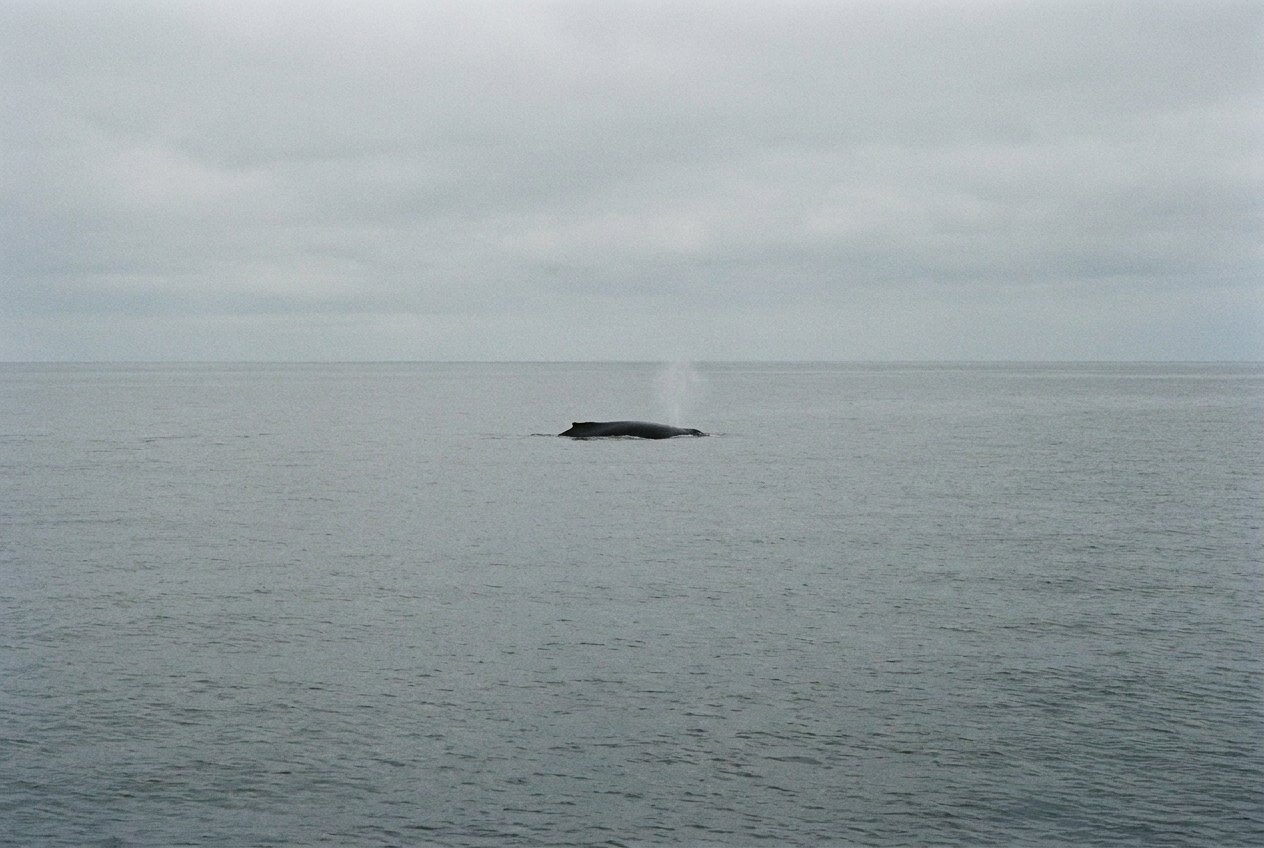
From a distance, look for a broad, smooth black back with no fin and a V-shaped blow, two plumes spreading apart, seen best from in front or behind. When it dives, a right whale often lifts wide, smooth, all-black flukes with a deep notch in the middle.
Right whales feed by skimming, swimming slowly with their mouths open through dense patches of tiny copepods near the surface or deeper down. That slow, near-surface feeding is part of what makes them so vulnerable.
Why it was called the right whale
The name is generally explained as a whalers' term: this was the right whale to hunt. It was slow, came close to shore, and floated when killed. Centuries of hunting reduced the population to a fraction of its former size before international protection in the twentieth century. Recovery since then has been slow, because the species breeds slowly and faces new dangers.
The move into the gulf
For a long time right whales spent their summers feeding mainly in the Gulf of Maine and the Bay of Fundy. In the 2010s their main food supply in those areas shifted with warming waters, and the whales followed their prey. Large numbers began turning up in the southern Gulf of St. Lawrence, in waters with busy shipping lanes and important fisheries.
 Photo by MODIS Land Rapid Response Team, NASA GSFC; PD source file
The consequences became clear in 2017, when a string of right whale deaths was recorded in the gulf. Investigations pointed to two main causes: collisions with vessels and entanglement in fishing gear. Both remain the leading threats to the species today.
Entanglement is not always fatal at once. A whale can drag rope and gear for months, losing condition, and females in poor condition breed less often. Researchers have also found that many right whales carry scars from past entanglements. That slow, hidden cost is one reason why the population has struggled even in years with few recorded deaths. Calves are born in winter off the southeastern United States, far from the gulf, so the whales you might meet here in summer have already travelled the length of the eastern seaboard.
Further along the coast: The pilot whales of the gulf
Speed limits and closures
Since then, Canada has brought in protection measures in the gulf that are reviewed and adjusted each year. In general terms, they include seasonal speed restrictions for larger vessels in parts of the gulf, and temporary closures of fishing areas when right whales are detected in them. Closures can be triggered by sightings from aircraft, vessels or underwater listening equipment, and they can change at short notice.
The details differ from year to year. If you are a visitor on land, the practical effect is mostly invisible, though you may hear fishers in harbour communities talk about closures. Many fishing families on this coast live with the uncertainty that the measures bring, and the debate over how to protect the whale while keeping fisheries working is real and ongoing.
Could you see one from Cape Breton
Right whales in the gulf are concentrated mostly in the southern and western parts, well away from the cliffs of the Cabot Trail. Sightings near Cape Breton's coasts are uncommon. If you are watching from a headland and see a large, finless black whale moving slowly, it is worth a careful look, but it is far more likely to be something else. Pilot whales are black too, but they are much smaller and have an obvious hooked fin, as described in the guide to pilot whales off Cape Breton.
On a boat, the rule is simple: if a right whale is identified, keep well away and move off slowly. Canadian rules set minimum approach distances for whales, and the rules for this species are strict.
Reporting a sighting
Because every right whale matters, sightings from the public can be useful. If you think you have seen one, note the time, your position as accurately as you can, the direction of travel, and anything you notice about the head, back and flukes. A photograph helps a great deal. Report it to Fisheries and Oceans Canada; the department publishes a contact line for marine mammal sightings, and it is worth saving the number before you head out. If you see a whale that is entangled, injured or dead, report it straight away and do not approach it.
Seeing a right whale is not the point of a trip to Cape Breton. Knowing a little about it helps you understand the gulf's other whales, the rules for watching them well, and the pressures on the whole sea around the island.
Back along the coast: Pleasant Bay · Further on: Cape Breton Highlands · Same stretch: Gulf of St. Lawrence, Gulf of St. Lawrence, Pleasant Bay, Cape Breton Highlands, Anywhere · the whole coast · logbook